

The 50/30/20 rule is a guide, not a promise about how much cash you’ll have left. To calculate money left after bills, subtract your committed bills and planned savings or reserves from your take-home income. The result is what remains for flexible spending, with the amount shaped by your pay schedule and upcoming costs.
It can seem as though there should be one right amount left after bills. But your bank balance may include money already committed to expenses due later, so looking beyond cleared transactions gives you a more realistic picture of what you can spend.
This article explains how to calculate what remains each month or pay period, account for less frequent expenses, and divide the balance between spending and savings. It also covers how budgeting rules can guide your choices and how an annual view can reveal costs that are easy to miss when planning month by month.
Key Takeaways
- Treat the 50/30/20 budget as a starting point, then adjust the percentages to fit your actual bills and pay rhythm.
- Turn irregular costs into planned reserves so expenses like car registration or birthdays don’t catch you off guard.
- Separate bills, savings, and flexible spending to give each part of your take-home pay a clear purpose.
- Review your budget across a full year to spot recurring costs that a month-by-month view can miss.
1. Is the 50/30/20 budget the only good rule of thumb?
No. The 50/30/20 guideline divides take-home income into needs, wants, and savings or extra debt payments: 50%, 30%, and 20%. It offers a clear starting point, but fixed percentages may not fit rent, utility bills, or paydays that vary. A monthly plan can look balanced while leaving too little before the next paycheck.
Include housing, utilities, food, transportation, insurance, taxes, and connectivity in your monthly budget. Add minimum debt payments, recurring subscriptions, and reserves for annual or irregular expenses. These costs count even when they do not arrive every month. Setting aside money for less frequent bills helps prevent you from overstating what is left to spend.
Zero-based budgeting takes a different route: assign every dollar of take-home income a purpose, including bills, savings, and flexible spending. The aim is to account for the whole income, not to spend it all. The 50/30/20 rule sets broad percentage limits; zero-based budgeting starts with actual expenses. Either method can help you calculate money left after bills, but neither removes the need to account for timing.
Consider the difference between a monthly budget showing $800 left and a paycheck plan showing $180 available before the next paycheck in 11 days. The first view may hide bills due soon. Paycheck budgeting maps income to expenses before the next payday, which can be useful when fixed bills cluster early in the month.
If essential expenses take more than your income can comfortably cover, percentage targets will not close the gap. List housing, utilities, food, and transportation first, then identify which commitments leave too little for other needs. Building an emergency fund may need to wait while essentials and minimum obligations take priority.
In high-cost areas, a 70/20/10 budget can be an alternative: 70% for needs, 20% for savings, and 10% for wants. Treat the split as a guide, then adjust it to match actual housing costs and income.
2. How Much Money Should I Have After Paying Bills?
There’s no single amount that fits every household. One useful measure is what remains after essential expenses, planned savings, and upcoming commitments. Middle-income U.S. households typically have 20%-25% of income left after essential expenses; lower-income households often have 10%-15%. These are broad patterns, not targets every budget can reach.
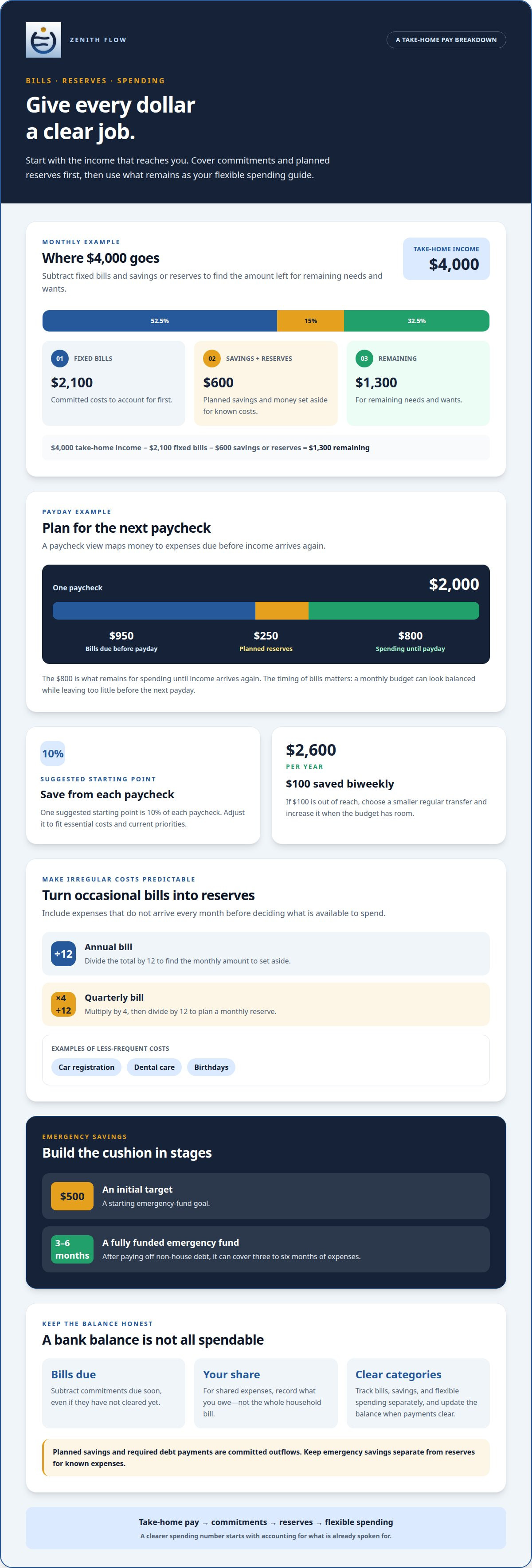
Include irregular expenses before deciding what’s available. List car registration, dental care, birthdays, and other costs that don’t arrive monthly. For an annual bill, divide its total by 12 and set aside that monthly amount. For a quarterly bill, multiply by 4, then divide by 12. This turns occasional payments into planned reserves instead of surprises.
Should savings and debt payments count as bills? Treat planned savings and required debt payments as committed outflows, even though they are not household bills. This gives you a clearer picture of what you can spend after meeting your obligations. Keep emergency savings separate from money set aside for known expenses, such as annual registration.
Your bank balance shows transactions that have cleared, not every dollar already committed. If rent, a debt payment, or a shared utility bill is due soon, subtract your share before treating the balance as spendable. For shared expenses, record what you owe, not the entire household bill. Include minimum debt payments before considering extra payments or flexible spending.
For example, after fixed bills and planned reserves, a budget might leave $1,300 for the month. Dividing by about 4.33 weeks gives roughly $300 weekly. This can help pace groceries and other flexible expenses between paydays. The amount you need to reserve depends on upcoming costs, shared commitments, and the timing of payments. Keep those amounts visible, and the remaining balance becomes a more useful spending guide.
3. Allocating take-home pay to bills, savings, and spending
Start with take-home pay: the income you receive after payroll deductions. Include wages and other regular income that actually reaches you, not gross salary before deductions. If your household income varies, plan around the amount available each payday.
Separate essential bills from flexible essentials. Rent, utilities, insurance, and minimum debt payments are commitments; groceries and transportation can change from week to week. Set aside planned savings and reserves before deciding how much flexible spending fits. In a monthly example, $4,000 take-home income minus $2,100 in fixed bills and $600 in savings or reserves leaves $1,300 for remaining needs and wants.
A paycheck view can make the next stretch clearer. From a $2,000 paycheck, assign $950 to bills due before the next payday and $250 to planned reserves. The remaining $800 covers spending until income arrives again. A budget spreadsheet or app can track bill due dates, paycheck amounts, spending, and savings in separate categories. Update the balance when a payment clears, so the plan reflects what remains.
How much should you save from each paycheck? One suggested starting point is 10% of each paycheck, adjusted to fit essential costs and current priorities. Saving $100 from each biweekly paycheck adds up to $2,600 per year. If that amount is out of reach, choose a smaller regular transfer and increase it when the household budget has room.
Build emergency savings in steps. A $500 emergency fund can be an initial target; after paying off non-house debt, a fully funded emergency fund can cover three to six months of expenses. To increase savings, direct part of a raise or newly freed payment toward that fund. Revisit the plan at payday, then check whether bills, transportation, and flexible spending still fit. That answers the main question: allocate income in order of commitment, then spend from the remaining balance.
4. Calculating annual money left after bills
To calculate money left after paying bills, subtract annual bills and planned reserves from your annual take-home income. This shows what remains over the year, rather than just after one payday.
Start by gathering recurring costs and less frequent payments. Add monthly rent, utilities, insurance, and subscriptions across the year. Convert weekly costs by multiplying by 52, then include quarterly and annual bills at their full yearly amounts. Add planned savings separately, so the final dollar amount reflects money already set aside.
An annual view can change how a budget looks. Someone earning $30,000 per year and spending 85% on essentials has $4,500 left annually. That amount can seem workable until costs missing from the first estimate are added. For example, the calculation can include mobile and internet bills that weren’t previously counted.
Including these costs reduces the annual leftover amount to around $1,600. The example shows why a monthly snapshot may overstate what’s truly available.
Use the result to make a practical plan. Divide the annual amount left into regular spending, savings, and a buffer for expenses that do not follow a monthly pattern. Compare your plan with actual payments as the year goes on. When subscription or utility costs change, update the total instead of relying on an outdated figure.
For a clearer view across paydays, track your budget across the year, including recurring costs and planned reserves. An annual total is useful because it puts every season’s commitments in view, not only the bills arriving this month.
Zenith Flow
Zenith Flow helps you see what’s available after upcoming expenses and planned savings are accounted for. If your balance changes as bills approach, it can bring recurring costs and the amount available to spend into one view. The app includes recurring expense management, a spending indicator, and a Plus simulator for exploring possible changes to your budget.
Use Zenith Flow when you want a clearer picture between paydays or when monthly totals do not show what is already committed. Its essential features are free forever, and Zenith Flow Plus unlocks additional planning tools with a one-time payment, not a subscription.
If you’d like to discuss using Zenith Flow to organize your budget, contact Zenith Flow.
Make your next payday easier to read
A budget is most useful when it helps you make a decision, not just record what has already happened. Choose one practical next step: set aside money for an upcoming expense, adjust flexible spending, or decide how much of your next paycheck can go toward savings. Revisit that choice when your income or commitments change.
The clearest way to calculate money left after bills is to account for what is already committed before treating your balance as spendable. You do not need to change everything at once. Regularly updating your plan can help you see where your money is going and make room for the choices that matter to you.
If you’d like a practical way to keep your budget in view, start using Zenith Flow. Take the next step at a pace that feels manageable, and let a clearer picture guide your decisions.
Frequently Asked Questions
How Much Money Should I Have After Paying Bills?
There is no single right amount for every household. The useful figure is what remains after essential costs, scheduled payments, and planned savings. If that money runs out before your next payday, review when bills are due and whether you are counting flexible costs realistically. A quick look at recent transactions can reveal which expenses are making your money harder to stretch.
How do I avoid living paycheck to paycheck?
Give each paycheck a job before spending it. Match the income to bills due before your next payday, then set aside money for groceries, transportation, and upcoming costs. If your plan repeatedly falls short, review recent pay periods to spot timing issues or recurring charges. Adjust one flexible category at a time, and direct any money freed up toward a cushion for future expenses.
What Counts as Fixed Bills?
Fixed bills are regular commitments whose amounts usually stay the same each billing period. Rent, a set insurance premium, and a fixed loan payment are common examples. A utility bill may arrive monthly but vary in amount, so track its due date separately from its exact cost. This distinction helps you plan for regular obligations without assuming every recurring expense is predictable.
What Are Essential Bills?
Essential bills support basic needs and everyday responsibilities. They commonly include housing, utilities, food, transportation, insurance, taxes, and connectivity for work, education, or communication. What counts as essential depends on what keeps your household safe and functioning. If money is tight, list these costs first, then separate required payments from optional subscriptions and other adjustable spending.
How do I convert a weekly cost into a monthly amount?
Multiply the weekly cost by 52, then divide by 12. The monthly figure is an average, not a prediction of each calendar month’s exact spending. Keep the weekly amount in your records too, so you can compare actual grocery spending with your regular routine.
How much should I save from each paycheck?
Choose an amount you can set aside consistently after accounting for essential payments and near-term costs. If your income varies, base the transfer on the paycheck you receive rather than assuming every pay period is the same. Review the amount when a bill ends or your income changes, then direct some newly available money toward savings. Consistency matters more than choosing a target your budget cannot support.


